


As we’ve noted before, the book of Psalms originated as a collection of ancient Israelite songs of faith. Much like our hymns today, they were organized along theological and thematic lines—in this case to mirror the story of Israel from the time of David until after the exile.1 Infused in these gripping stanzas are David’s full, vivid spectrum of emotions: lament and praise, anger and joy, grief and healing and everything in between, all processed within the context of God’s unending goodness and righteousness.
Psalm 40 specifically describes a reiterating cycle of rescue and renewal—a perfect reflection for our Easter celebrations. In it, David moves from death and despair to solid ground and gratitude to testimony and praise, then right back to seeking God’s help again. We are invited to see our own stories in David’s song, and to find company and comfort in knowing we share in a cosmic dance of faith that has been swirling throughout the ages.
With this context in mind, we can break Psalm 40 down for our own lives today in the following way (paraphrase mine):
Verses 1-2: Though we may have to wait for the answers we seek—eagerly, patiently, with perseverance2—God hears us when we seek and pray, and God rescues us.
Verses 3-4: Beyond personal blessing, God’s work in and for us is meant to produce praise and powerful testimony, opening doors for others to trust God and be happy.
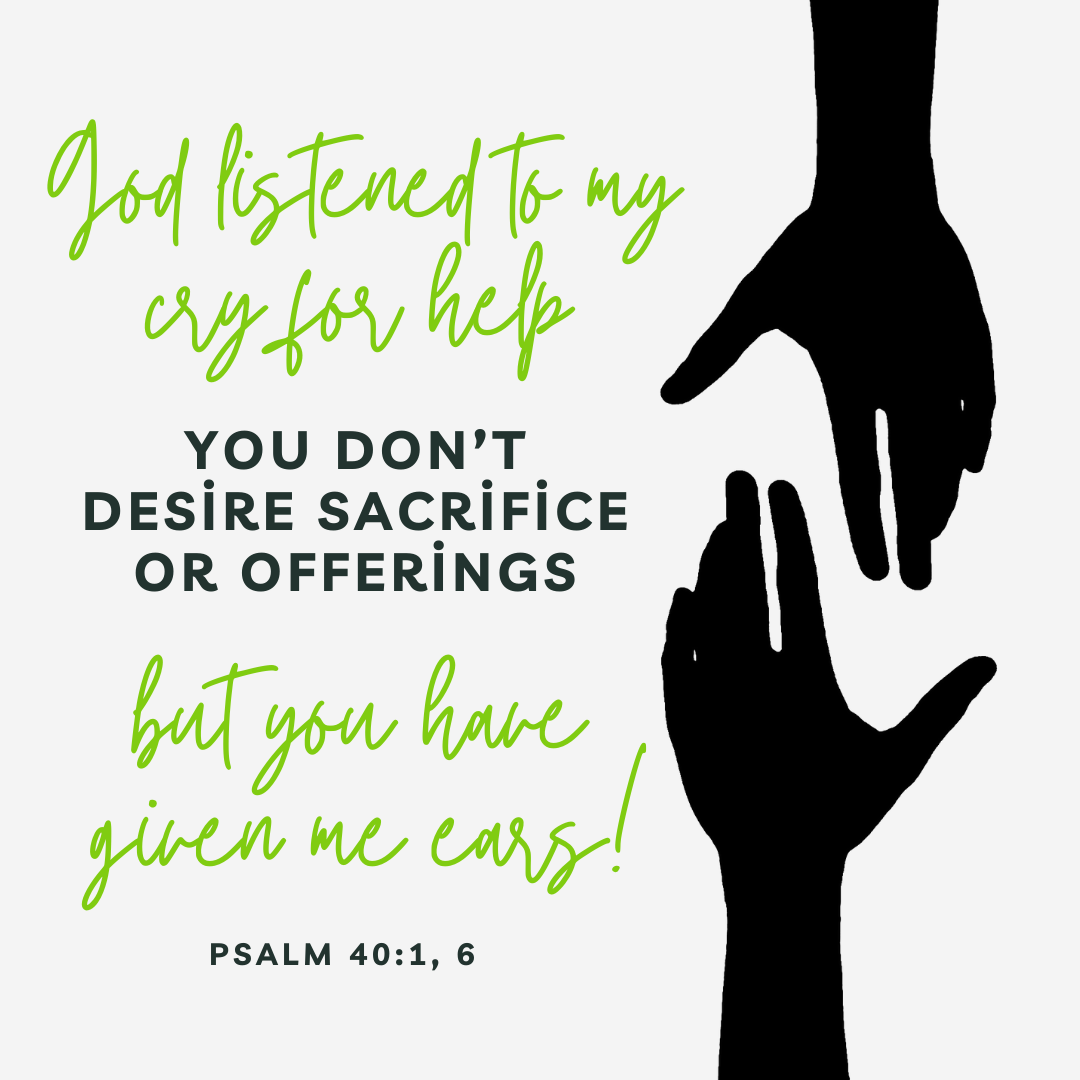
Verse 5-10: Even then, words are not enough. True gratitude authentically given moves beyond the verbal or even sacrificial; we must allow God to open (literally dig/excavate3) our own ears so we can hear and respond to the cries of others. Prayer changes things by changing us. We are, as ever, blessed to be a blessing.
Verse 11-17: This is hard work. The opposition of the world system and our own fallibility are ever against us. Thus, we return to God for help continuously and begin the work anew time and time again.
God listens, God cares, God helps, and God equips us to help in return. There is no greater thanks.
Footnotes
- Fee, G. and Stuart, D. (2014). How to Read the Bible Book by Book: A Guided Tour. p. 133 Zondervan ↩︎
- https://www.blueletterbible.org/lexicon/h6960/nasb20/wlc/0-1/ ↩︎
- https://www.blueletterbible.org/lexicon/h3738/nasb20/wlc/0-1/ ↩︎


Thank you for the reminder that it’s an everyday endeavor. Happy Easter!
Sent from my iPhone
LikeLike