


Last week, I had sort of an accidental crossover moment with Elmo. Yes, THE Elmo of Sesame Street fame.
In case you haven’t heard, Elmo made this fairly run-of-the-mill Monday morning post:
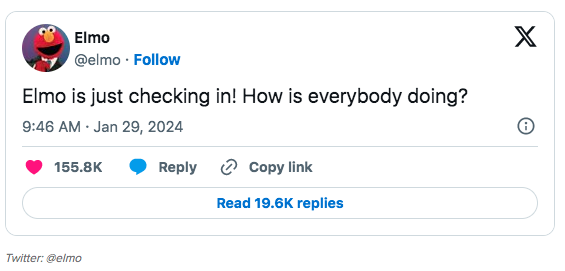
The response was immediate, loud, uninhibited, and likely far more than the eager little monster and his handlers could have possibly predicted. In short: People are not doing okay—or at least, thousands of people who felt strong, invested, and confident enough to respond are not—and the post went viral.
On a much smaller scale, I impulsively posted my own little check-in of sorts the night before, and it generated an unexpected response as well. Here’s what I said:
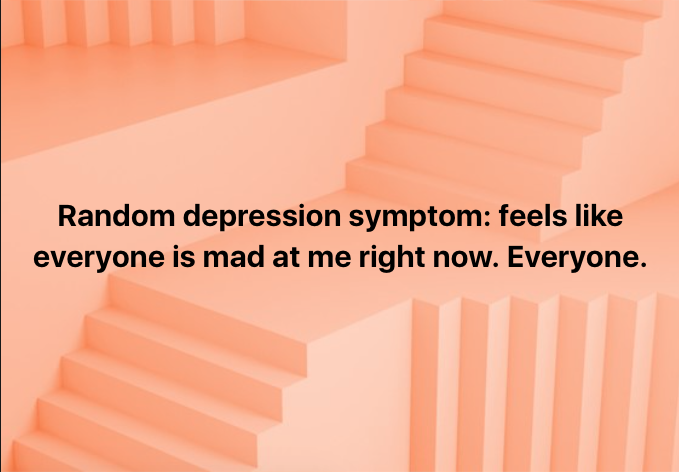
I was having a bad day, to be sure, but my emotional landscape was not as bleak as I was soon to discover it came across. What I meant to do was express my surprise at this new symptom experience while keeping my word count small enough for Facebook to retain the cool Escher-y steps image in the background. And while fewer words usually serve my communication purposes better than lengthy expositions, in this case it caused a number of people to jump to attention and reach out to me. I received several comments, DMs, texts, and phone calls from people inquiring if I was okay.
For the record, the answer to that question is (as is usually the case) both yes and no. I am not in a state of danger to myself or others, but depression I have always with me. In her book, Accidental Saints, Nadia Bolz-Weber wrote of her depression as “so present, so much like a character in my life, that it had actually felt right to go ahead and give her a name.” She named her depression Frances (because she emerged around the same time as Frances Bean was born), and I have found it helpful to follow this example. My depression’s name is Trixie—a little on the nose, I know, but when I think of her, and especially when I actively confront her, I think of Gollum arguing with himself and all the confused, earnest, anguish that goes with it. Also because she’s gross.

Trixie has been developing some new tricks, as it were, of late, and this one I have since learned is a cognitive distortion known as Mind Reading. As Nandita Bhaskhar of Stanford University describes it, “Think of the world as a radio station that’s broadcasting music…Sometimes, the signal from the station may be distorted because of bad weather. But more often than not, the static is just a result of improper tuning. And once you tune the radio, almost miraculously the harsh and grating sound turns into a beautiful melody.”1 The Mind Reading distortion uses emotions to interpret a situation, event, or experience with no factual evidence to support the conclusion, or sometimes forms conclusions in direct contradiction to the evidence. Healthy mental tuning will reverse the process, taking in data objectively and refocusing emotional responses based on what is known to be true.

What always amazes me about depression is how it—technically a mere intangible state of perception with no physical form to speak of—manages to protect and defend itself just like a virus, sentient being, or other life form. Symptoms by their very nature cut us off from the things that would help us (connection, activity, nutrition, etc.), just like prey avoiding a predator, thereby allowing the depression, anxiety, and ongoing imbalances to thrive. This is one reason I have personified it; because it behaves more like an antagonist than an interaction of synapses and chemicals in the brain.
My experience with this cognitive distortion was a perfect example. I didn’t have a sneaky, pervasive feeling that everyone was in love with me, or speaking well of me, or conspiring to elevate me in some way. That would make me feel good and empower me to do more healthful things for myself. Instead, Trixie could only offer me negative and self-defeating impressions to fixate on, shutting me down and thereby feeding the depression and whatever particular source it was coming from that day.

Joke’s on her, though, because whenever I can muster the presence of mind and strength to wield it (or stumble into it, as I did last week), there is one weapon that always wipes her out: fresh air. When I talk about my symptoms, I open the door of my thought life to breath and life and Spirit, and Trixie is immediately revealed for the charlatan she is and driven back into hiding. This is not always an easy fix; sometimes, I can get there through prayer and meditation or cognitive behavioral therapy practices, sometimes I need the help of medication or professional intervention. Yet however I can make it happen, the result is always the same: Trixie crawls back under her rock, and I remember what is true: that everything is going to be okay, that I am never alone, and that I am loved—both by Creator who formed me, and by a number of people who pay attention enough to be alarmed when I make random, cryptic, accidental calls for help on my socials.
If you were one of them, thank you.
And if you are someone battling a Trixie/Frances/Gollum of your own, please reach out. Crack that door. You can message me here or on socials if you like, or for anonymous, 24/7, expert help (that good, pure, Grade A oxygen), try texting HOME to 741741.
You deserve all the good things, and you are loved.

Footnotes
- Bhaskhar, Nandita. 2020. “Understanding Your Cognitive Distortions.” Nandita Bhaskhar (blog). March 18, 2020. https://web.stanford.edu/~nanbhas/blog/understanding-cognitive-distortions/. ↩︎


 Lucinda S. Sutton
Wonderful take on a difficult subject.
LikeLike