


The Gospel of Luke is traditionally credited to Luke, the “beloved physician” (Colossians 4:14), and the majority of scholars agree there is no reason to challenge this tradition.1 Luke’s gospel is part one of two in a larger narrative which includes the book of Acts, and the intent was always for them to be read together as one story.2 About half the book of Luke is comprised of unique material found nowhere else, including the annunciation and nativity narratives (Luke 1-2), Jesus’s inaugural sermon (4:14-30), and Jesus’s words on the cross (23:34, 43, and 46), as well as five miracle stories and seventeen parables. Recurring themes within his unique narratives include riches and poverty, the significance and presence of women, ministry among Gentiles (especially Samaritans), and time spent in Jerusalem.3 Luke’s primary focus in the complete Luke-Acts story is God’s acceptance, forgiveness of sinners, and good news to those who are marginalized by societal and religious systems.4

Today’s passage is a beautifully written portion of the nativity story, made particularly famous by its inclusion in the 1965 TV special, A Charlie Brown Christmas (which very nearly didn’t air at all; thank God for the tenacity of Charles Schulz and the relentless programming schedules of the day!5). It describes Jesus’s birth announcement to a group of what may well have been very special shepherds entrusted with the flocks from which the Temple offerings were chosen.6 Despite the sacred necessity of their job, they would still have been despised by orthodox “good people” in that time due to the unclean state their work kept them in…and yet, we get the sense that this was exactly what made them God’s most desirable audience for this earth shattering, time-altering, eternally resonant moment. The angel had three things to tell the shepherds―and through them, all the world (paraphrase mine):
- Don’t be afraid.―Not just of me (for I am here as a friend), nor of this supernatural moment (because it is for this very breakthrough of heaven to earth that you have been chosen), but also not ever again (for what you are about to hear is good news which has the power to allay the fears of all people forevermore).
- Your Savior, Christ the Lord, has arrived.―No more waiting. The era of the Messiah, the launch of your restoration and restitution, the dawn of the age of promises fulfilled is now upon the earth. All is beginning to be well.
(Note: This is the only place where the phrase, Christ the Lord comes together in this way, one indication being that the Lord corresponds to Yahweh: that the Messiah is from God, and the Messiah is God.7 ) - Here’s how you’ll know it’s real.―You don’t have to guess or wonder or search aimlessly to figure it out. God gives clear markers to find and follow the Way; whether and how we get up and walk it is always up to us.
After the single angel’s announcement, a whole host of angels appeared, a band of spiritual defenders proclaiming:
- Peace―The world needed then and needs now peace: not just an absence of war, but complete wellness for all of creation. As Epictetus, a first century writer said: “While the emperor may give peace from war on land and sea, he is unable to give peace from passion, grief, and envy; he cannot give peace of heart, for which man yearns far more than even outward peace.”8
- Good will toward humanity―God’s love comes from heaven to rest upon all of us as it did upon Jesus Himself, in whom God is “well-pleased” (Mathew 3:17, the exact same word as is used here).
- Praise―Let God have the credit/honor for this work: Glory to God in the highest, even as people have the benefit of it: On earth peace, goodwill toward humanity. 9

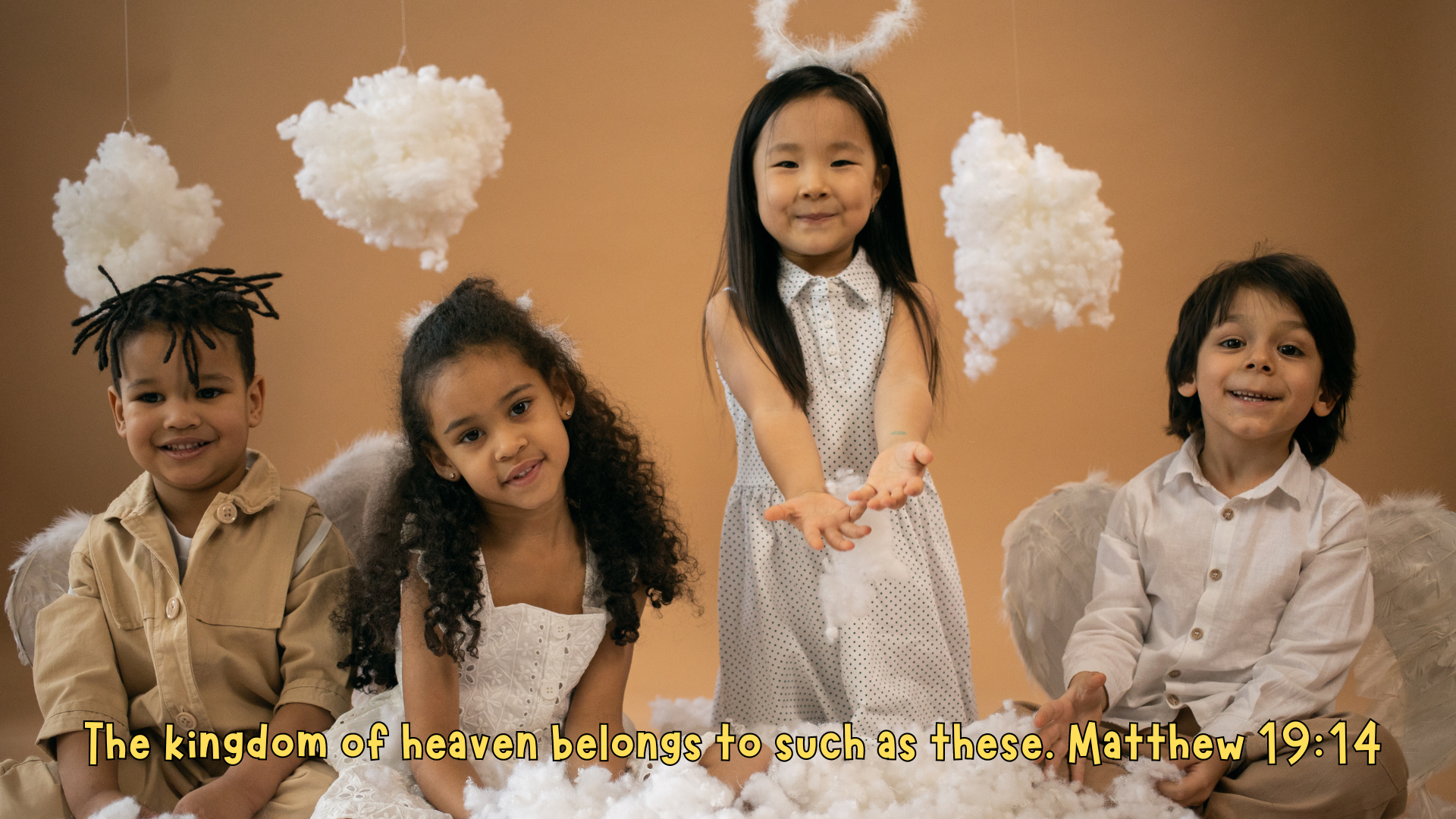
Jesus was born into poverty on the margins of society (Luke 2), and his family fled their homeland as refugees when Herod sought to kill him (Matthew 2). Quite clearly in his own words, Jesus came to liberate the poor, the captive, the oppressed (Luke 4:18-21). To honor Jesus (at Christmas and always) is to move the Gospel beyond concepts and possibilities into action and love; thus, there is no better time than at the birth of the Christ-Child to focus light on challenges confronting children in the United States and throughout the world.10 As of 2021, the Children’s Defense Fund reported the following startling statistics regarding the lives of children in the United States11:
—1 in 7 (or 12 million) American children qualify as poor, with an annual household income of $27,740 or less. Approximately 72% of those are children of color, and 2 in 3 live in working families.
—About 1 in 20 (or 4 million) children have no health insurance. Children’s access to health coverage and services across the United States remains a lottery of birth and geography.
—Center-based child care for infants is more expensive than public college in 34 states and the District of Columbia. And yet, the average hourly wage for child care workers is less than half of a living wage for a single parent in all 50 states and D.C.
—One child is reported abused or neglected every 11 seconds (about 580,000 children annually…not accounting for those who go unreported).
—Firearms are the leading cause of death among children. One child or teenager is killed by gunfire every two hours and 40 minutes.
—The U.S. spends far more on incarceration than education: on average, about 2.7 times as much per prisoner as per public school student in the last five years.
—An especially underserved group of children are those of the incarcerated. This is of particular significance to people of color, since inmates in this country are disproportionately African American and Hispanic.
These are the innocents, and their blood and tears cry out from the ground. As followers of Jesus, it is only right that we pause and ask ourselves: what are we doing (collectively and individually, not just at Christmas, but year-round) to improve this reality for children? How are we contributing to the success and welfare of children? Do we inform our conversations with data and compassion? Do we effectively implement programs, policy advocacy, and strategies to improve the odds for children in our states and nationwide?
As the old adage tells us, it is more blessed to give than to receive. May the nativity story this year energize us not merely to be passive receivers of peace and good will, but to bring peace, good will, and wellbeing to all the children (and all the people) we can in our decision-making every day.

Footnotes
- Powell, Mark Allan. Introducing the New Testament: A Historical, Literary, and Theological Survey. United States: Baker Publishing Group, 2009. ↩︎
Fee, Gordon. 2009.
(Fun Bible trivia fact: Luke himself was a Gentile, making him the only known non-Hebrew/Jewish writer of the Bible.) ↩︎ - Fee, Gordon D. How to Read the Bible Book by Book: A Guided Tour. United States: Zondervan, 2009. ↩︎
- Powell, Mark, 2009. ↩︎
- Fee, Gordon. 2009. ↩︎
- Daniel Ross, “Charles Schulz ~ Good Ol’ Charles Schulz,” PBS, April 18, 2023, https://www.pbs.org/wnet/americanmasters/charles-schulz-good-ol-charles-schulz/86/. ↩︎
- Barclay, William. New Daily Study Bible, Gospel Set. United States: Presbyterian Publishing Corporation, 2017. Accessed December 8, 2023 at https://www.studylight.org/commentaries/eng/dsb/luke-2.html ↩︎
- Jamieson, Fausset & Brown. “Commentary on Luke 2 by Jamieson, Fausset & Brown.” Blue Letter Bible. Last Modified 19 Feb, 2000. https://www.blueletterbible.org/Comm/jfb/Luk/Luk_002.cfm ↩︎
- Guzik, D. “Study Guide for Luke 2 by David Guzik.” Blue Letter Bible. Last Modified 6/2022. https://www.blueletterbible.org/comm/guzik_david/study-guide/luke/luke-2.cfm ↩︎
- Henry, M. “Commentary on Luke 2 by Matthew Henry.” Blue Letter Bible. Last Modified 1 Mar, 1996. https://www.blueletterbible.org/Comm/mhc/Luk/Luk_002.cfm ↩︎
- Jones, Kirk B. “Christmas,” The African American Lectionary, December 25, 2008. Accessed December 8, 2023. http://www.theafricanamericanlectionary.org/PopupLectionaryReading.asp?LRID=59 ↩︎
- Children’s Defense Fund, “State of America’s Children 2023,” June 7, 2023, https://www.childrensdefense.org/wp-content/uploads/2023/06/SOAC-2023-Tables-6.7.23.pdf ↩︎


 Lucinda S. Sutton

Horrifying statistics. We can and must do better.
LikeLike