

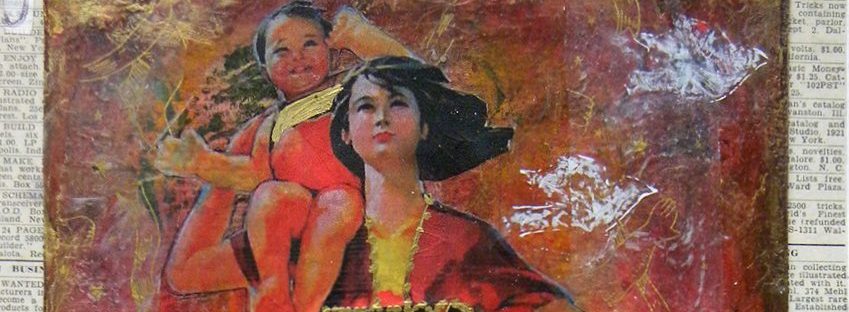
The Magnificat is my favorite part of the Christmas story. Mary’s song sums up the entire human experience of Advent – seeing and being seen by God, and bearing God’s love and fulfilled promises into the world. I hope you will enjoy my playlist of Christmas songs which are also Mary’s song, and some of my favorite readings about Mary, why we should care about and represent her better than we do.
from Nadia Bolz Weber’s Sermon on Mary
I think the prophet Mary of Nazareth had a particular wisdom from God. I’m not convinced that she was perpetually full of nothing but virtue, virginity, and pure receptivity. But I am sure she wasn’t just another Joe Schmo who doesn’t deserve any more honor given her than any other character in the Bible…I think Mary deserves our devotion because in her we see what casting our lot with and being blessed by the God of Israel really looks like. She got something I really struggle to understand: that getting a blessing is not the same as getting a present. She said yes not based on the expectation of things being awesome for her but based on the expectation that God can create something out of nothing.

from Richard Rohr’s Mary Is Our “Let It Be!” Homily
The Holy Spirit is never concocted by our actions or behavior. The Spirit is naturally indwelling from [the first moment of our existence] (Jeremiah 1:5); it is our inner being with God. The True Self—where you and God are one—does not choose to love as much as it is love itself already (Colossians 3:3-4). From this more spacious and grounded place, one naturally connects, empathizes, forgives, and loves everything. We were made in love, for love, and unto love. This deep inner ‘yes,’ that is God in me, is already loving God through me. And that is the ‘yes’ of Mary…

from Rachel Held Evans’s Mary, Mother of God
We encounter Mary as Theotokos—the Mother of God, a Greek term which beautifully connects the humanity of Mary with her divine call. It more accurately means “God-bearer” or “the one who gives birth to God.” Theotokos refers not to Mary as the mother of God from all eternity, but as the mother of God incarnate. She is what made Jesus both fully God and fully human, her womb the place where heaven and earth meld into one. At the heart of Mary’s worthiness is her obedience, not to a man, not to a culture, not even to a cause or a religion, but to the creative work of a God who lifts up the humble and fills the hungry with good things. One need not be a saint, or a mother, to become a bearer of God. One needs only to obey. The divine resides in all of us, but it is our choice to magnify it or diminish it, to ignore it or to surrender to its lead.

from Jan L. Richardson’s Circle of Grace: A Book of Blessings for the Seasons
A Blessing for After
This blessing
is for the moment
after clarity has come,
after inspiration,
after you have agreed
to what seemed
impossible.
This blessing
is what follows
after illumination departs
and you realize
there is no map
for the path
you have chosen,
no one to serve
as guide,
nothing to do
but gather up
your gumption
and set out.
This blessing
will go with you.
It carries no answers,
no charts,
no plans.
It carries no source
of light
within itself.
But in its pocket
is tucked a mirror
that, from time to time,
it will hold up to you
to remind you
of the radiance
that came
when you gave
your awful and wondrous
yes.
—Jan Richardson
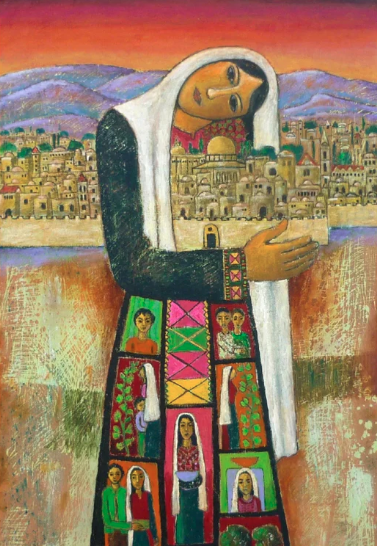
“May I Introduce Mary of Nazareth” by Joan Chittister
Mary of Nazareth knew very well what it meant to be strong.
She was strong enough to know that she had been favored by God when the society said she couldn’t be so favored, and the tradition said she wouldn’t be so favored.
She was strong enough to realize the strength of another woman when she went to Elizabeth for support and affirmation rather than to the synagogue to try to persuade the priests of the legitimacy of their visions, or to the government for protection, or even to the men to whom they were espoused to explain or cajole or plead.
She was strong enough to bring the right concerns, the right questions, the right witness, the right insight into our world, even if it meant questioning the angels.
At Cana she was strong enough to insist on miracles and to get them.
She was strong enough never to give up, not to be afraid, to begin over again and again and again, after Bethlehem, and after Egypt, and after the crucifixion.
Mary is not simply “Mary, the Mother of God.” No, on the contrary. The Mother of God is the image of women everywhere. The Mother of God is Mary, independent woman; Mary, the unmarried mother; Mary, the homeless woman; Mary, the political refugee; Mary, the Third World woman; Mary, the mother of the condemned; Mary, the widow who outlives her child; Mary, the woman of our time who shares the divine plan of salvation; Mary, the bearer of Christ.
Mary of Nazareth made feminism an article of the faith, and power holy. Mary shows us the sanctifying power of a human being who has become fully human.


 Lucinda S. Sutton
Love the playlist. Thank you.
LikeLike