

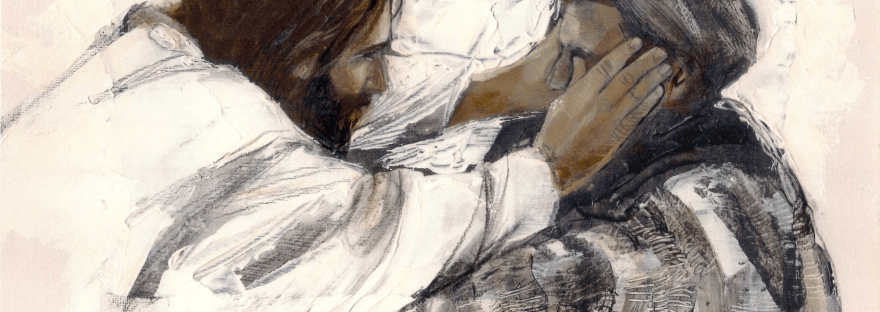
(This is an excerpt from Spring Clean: Devotions for Lent, Day 27. It also “happens” to be the text on which my pastor spoke in church yesterday, as well as the Bible story that moved my heart to become a Jesus-follower when I was a child. Presented here today with prayers and hope for healing in us all, this Holy Week and ever forward.)
Jesus spit on the ground, made mud from the saliva, applied the mud to the blind man’s eyes, and said to him, “Go, wash in the pool of Siloam” (which is translated, Sent). So he left and washed, and came back seeing. John 9:6-7
One day, Jesus and his followers encountered a man who had been blind from birth. The disciples observed the man and saw a question to be answered: “Who sinned, this man or his parents, that he would be born blind?” (John 9:2). By contrast, Jesus saw a need to be met. He refocused their attention away from blame and speculation onto the much more pertinent question, What can God do in this? Jesus did not put off helping the man to a more private (safe) time or place, nor to a more public (attention-seeking) one, nor to after the Sabbath, when it would have created less controversy. The man had endured judgment and exclusion long enough; the time to love and heal was now. So Jesus immediately created a rough version of clay, applied it to the man’s eyelids, and directed the man to wash it off in the Pool of Siloam to complete his healing. The man faithfully followed Jesus’s instructions, thereby becoming the first person born blind to be healed of their blindness in biblical record.
Jesus’s compassion and interaction with this man carry great spiritual implications in the context of the Feast of Tabernacles, which had ended just before this story took place. Also known as Sukkot, this pilgrimage festival was given to be a joyful commemoration of God’s provision and protection during the Hebrews’ 40 years in the desert (Leviticus 23). On the final day of celebration, a priest would descend to the Pool of Siloam, fill a pitcher with water, then pour the water over the altar while the people cheered and sang. The pool and its water had no inherent mystical properties of their own, but the ritual was regarded by the Rabbis as symbolic of the pouring out of The Spirit in the latter days. It also hearkened to a prophecy in Isaiah 12: “Behold, God is my salvation. I will trust and not be afraid, for God is my strength and song…Therefore [we] will joyously draw water from the springs of salvation (verses 2-3).” On this particular Sukkot, Jesus had declared to the people, “If anyone is thirsty, come to Me and drink. The one who believes in Me, as the Scripture said, from their innermost being will flow rivers of living water” (John 7:37-38).
Water is referred to about 700 times in the Bible, from the very beginning (Genesis 1:2) to the very end (Revelation 22:17). Both Old and New Testament writers used water to symbolize spiritual cleansing, salvation, and eternal life (Isaiah 55:1, Ezekiel 36:25, Ephesians 5:26, Hebrews 10:22, Revelation 21:6). Jesus sent the blind man to wash in the same waters which represented both the presence of God’s Spirit and the Living Water found in Jesus himself (John 4:10-14). Once again, the cure was not in the water, but in the One who created and ordained it.
Water is life. We are spiritual creatures inhabiting physical bodies, and both aspects of ourselves need water to keep us alive. In the same way that our bodies weaken when we don’t get enough water (often before we are even aware of it), so our spirits suffer when we neglect to imbibe, immerse, and cleanse our souls in the living water offered freely by our Creator and Redeemer. In this water, we find comfort and healing.
In Jesus, we see and are seen.


 Lucinda S. Sutton