


If you had asked me even one month ago whether I knew the story of the Compassionate (Good) Samaritan, I would likely have responded with pride in my heart: both the good kind of pride (in my history and heritage of Bible scholarship basically since birth) and the puffed up, annoying kind (um yeah, I’ve known that story since I was learning to read it at the age of four, I probably know it better than you, come at me, bro). I knew it was a parable Jesus told in response to a public challenge by an expert in religious law, that it both reinforced said law and upended his listeners’ understanding of how to live it out, and that it is a brilliant, beautiful story which still permeates our cultural narratives today, even among people who have never so much as picked up a Bible.
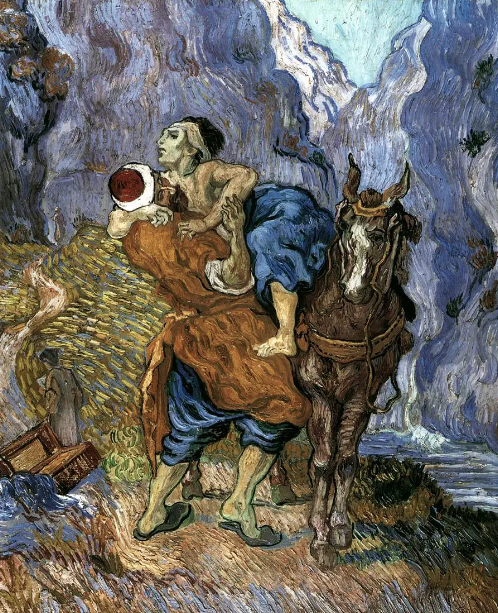
I had not, however, understood the full implications for the religious leaders represented and their ongoing choice between duty and kindness until just this week. In my readings from The CEB Storytellers Bible on Tuesday, I learned (all paraphrasing mine):
This parable has tones of legalism and organizational worship vs. compassion and justice. The priest and Levite — by touching what for all they knew may have been a corpse — would render themselves unclean, and thus on unpaid leave from their services until reinstated. Such reinstatement required the long, complex ceremony of the red heifer,1 which would leave themselves and their households unprovided-for until complete. In that moment on the road, they would have perceived they were caught between love for God via obedience to the Torah or love for God via an act of kindness. Jesus’s clear message was that the latter was and is the superior choice.
Furthermore, in Jesus’s description, the Samaritan’s first action was to bathe the victim’s wounds with wine (an astringent and disinfectant) and oil (a balm for pain), then to bandage them. Wine and oil were also well known libations included in sacrifice rituals in the temple. The Samaritan’s use of them created an act of worship in tending to the traveler, uniting love of God and love of neighbor in a single choice. The Samaritan fulfills the prophetic hope for worship to eventuate in lives of justice and mercy (Hosea 6:6, Micah 6:7-8).

Showing kindness for another is at the center of the nature of God, and it is the epitome of Judeo-Christian ethics. Jesus’s closing admonition to “Go…” makes the story an example for the lawyer and for listeners then and now. We too should fulfill love for God and love for neighbor by responding with compassion to the victims alongside the road of life.2
Versions of the word neighbor occur about 136 times in scripture, all but 25 of which are in the Old Testament.3 Jesus’s parable flipped the common understanding of the word away from a designation by which to qualify people around us, and into a mindset of purpose, something which we are and do for other people. Always more important than following the rules is giving of ourselves in tending to the care and healing of our fellow travelers. As counterintuitive as it may feel (especially to us Bible experts), this is how the Way of Jesus not merely keeps the Law, but brings it into the fullness of God’s intent and heart for all people.
“Go and do the same…”

Footnotes
- https://www.biblegateway.com/passage/?search=numbers+19&version=NASB ↩︎
- 2017. The CEB Storytellers Bible. Common English Bible. p.1402-1403 ↩︎
- “BibleGateway – Keyword Search: Neighbor.” n.d. https://www.biblegateway.com/quicksearch/?quicksearch=neighbor&version=NASB. ↩︎


 Lucinda S. Sutton
1 thought on “Like a Good Neighbor”