

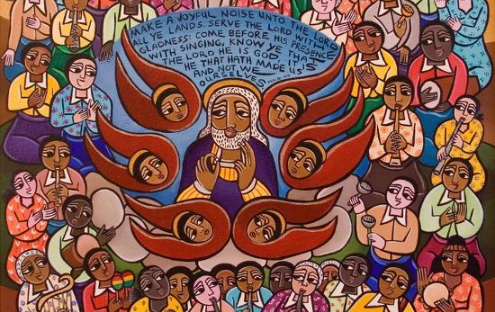
The book of Psalms originated as a collection of ancient Israelite religious songs. While most of the individual psalms were written before the Babylonian exile (597 BCE), the grouping as we have it now served as the hymn book of Second Temple Judaism (516 BCE―70 CE). Similar to our hymn books today, Psalms was not designed to be read through from end to end as doctrine, but rather was organized along theological lines to reflect the faith and experiences of the people within the seasons of their overarching narrative.1
The arrangement of the psalms into their five books served as a mirror of Israel’s history from David’s reign through the exile. Book 4 (Psalms 90-106) specifically encapsulated the perseverance of hope and faith in the aftermath of Jerusalem’s destruction as well as the absence of a king from David’s line. Themes include God as the true dwelling place, God’s sovereignty and justice, and celebration of God’s reign over all creation.2

Accordingly, Psalm 100 employs a regal tone because it was written to invoke the same response to God as had previously been given to the king. The Israelites lived under monarch rule for about 500 years before the events of the exile, and their king was held responsible for their spiritual and physical wellbeing. His role included defending them against enemies (1 Samuel 8:20), pronouncing judgment over their disputes (2 Samuel 15:2; 1 Kings 3:16), modeling the Law (1 Kings 21:4), praying for and blessing them in the name of Yahweh (2 Samuel 6:18; 24:25; 1 Kings 3:4,8; 8:14,55,62; 9:25), and representing the unity of heavenly and earthly rule over Israel as Yahweh’s anointed substitute (1 Chronicles 17:14; 28:5; 29:23). In the absence of these ministries by a human king, psalmists redirected the people’s attention to picturesque reminders that Yahweh was still with them and was their true, original Defender, Ruler, Minister, and Source from the beginning.
Psalm 100 is a perennially popular scripture at Thanksgiving dinners and worship services. With the above context in mind, we can break it down when we hear it for our own lives today as (paraphrase mine):
- Verses 1-2: God has given all people, tribes, creatures, and lands a purpose filled with meaning and joy. Let’s celebrate!
- Verse 3: Know, remember, learn, perceive, acknowledge, and discern3 that literally everything comes from Creator. There are no “self-made people,” so let’s embrace humility which enables a healthy posture of gratitude and thriving.
- Verse 4: No matter what else is happening in our lives and the world, the true Sovereign Monarch’s stronghold still stands and its gates are wide open for all to enter and receive and be safe. Join the parade as we walk in together, remembering to vocalize our exuberant thanks for the gifts!
- Verse 5: In God’s care, there are certainties we can always count on:
God is good, pleasant, agreeable, benign, and understanding4
God is loving, kind, and compassionate5
God is faithful, firm, steadfast, and steady6
We are not just arbitrarily floating around out here. Everything is going to be okay.

Footnotes
- Fee, G. and Stuart, D. (2014). How to Read the Bible Book by Book: A Guided Tour. p. 133. Zondervan ↩︎
- Fee and Stuart, p. 132. ↩︎
- H3045 – yāḏaʿ – Strong’s Hebrew Lexicon (nasb20). Retrieved from https://www.blueletterbible.org/lexicon/h3045/nasb20/wlc/0-1/ ↩︎
- H2896 – ṭôḇ – Strong’s Hebrew Lexicon (nasb20). Retrieved from https://www.blueletterbible.org/lexicon/h2896/nasb20/wlc/0-1/ ↩︎
- H2617 – ḥeseḏ – Strong’s Hebrew Lexicon (nasb20). Retrieved from https://www.blueletterbible.org/lexicon/h2617/nasb20/wlc/0-1/ ↩︎
- H530 – ‘ĕmûnâ – Strong’s Hebrew Lexicon (nasb20). Retrieved from https://www.blueletterbible.org/lexicon/h530/nasb20/wlc/0-1/ ↩︎


 Lucinda S. Sutton
Lovely.
LikeLiked by 1 person